Back to Gimmewald!


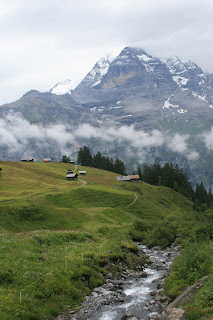
While I’m by no means a creature of habit, there are a handful of things in this world which are worth repeating. And while we’re trying to see as many different places as possible while in Europe, if there’s one place I could return to every year, Gimmewald would be that place. Although it’s only a small swathe of maybe 30 wooden mountain houses, you never run out of things to see. Goats and calves eating grass inches from the town’s only street; water fountains cascading into hollowed-out logs; farmers working their fields by hand because the mountain is too steep to use machines. Mountain vistas, fresh alpine air. Did I mention cows? Swiss cows personify just about everything in the world that is awesome, rolled into the shape of a bovine. They rule.

My parents were still in town trying to get a feel for Switzerland, so I figured this would be the perfect place to take them. As luck would have it, we’re now considered regulars in Gimmewald, so we were able to get the hook-up and secured “the” hotel room with a balcony (only about three hotels in the town). This allowed us to sit for hours on the deck and stare at the mountains while smoking Cuban cigars - and while I’m not big on cigars by any means, I am big on sitting on decks staring at mountains, so it worked out well. The most stressful thing we encountered was trying to time the opening of the cheese hut in order to get some fresh mountain produce, something we were able to get around due to the fact we were a two-minute walk from the hut.

Of course, the main appeal of this area is the hiking. This time around, Soph and I hiked through the forest to a waterfall, while my parents went to the top of the Schilthorn to see the majestic peaks the Bernese Oberland is known for. We also hiked the easy route from Wengen to Kleine Scheidegg, affording a great view of the Eiger’s North Face. The fun thing about the hiking here is that you can pretty much take off in any direction and end up with that “good hike” feeling. Sometimes you can take a half-hidden trail that will lead you to a small winter hut that farmers use, while signs will point you in the general direction of mountain restaurants that serve snacks and other homemade goods. Streams and pastures lie in every direction, so you can explore until you get tired of walking. And if you’re not up for walking, you can just sit around and enjoy the mountain air while sitting on the edge of a precipice - or in a meadow, if you’re not big on precipices.

Definitely beats sitting in a cubicle.

Next weekend: Nice!

Tuscany!

The rolling hills of Tuscany…an area known for invoking thoughts of good living, fine eating, and a certain slowness to life. We took a morning train out of Rome (where my dad became fast friends with an older Italian couple, who fed him lunch) and headed north to enjoy one of the famous agriturismo’s atop a small Italian village.


An agriturismo is a relatively recent concept in the vacation dictionary. Set in remote (i.e. not accessible by public transportation) areas, they are essentially working farms that produce everything from fresh eggs to homemade wine. Ours also had a pool that overlooked a huge valley, so needless to say it was pretty awesome. They even had peacocks! Although after being subjected to their annoying calls for a week, I’m fairly certain that I will never own one of those things myself.

From here we were able to visit all sorts of Italian hillside towns. Siena, Montepuliciano, Montalcino, and a couple of other ones beginning with “mon” and ending with “ino” (hard to keep track of them after awhile.) Once in a hillside town, you pretty much just walk around and look at things. It’s fun, but there’s not too much to describe other than that. Get a gelato, find a cool shop, walk down narrow alleys, try and see a vista overlooking the countryside, get another gelato…good stuff. Of course, different people find different shops interesting. For example – my parents enjoyed the pottery shops, my sister the purse shops, and Soph enjoyed any shop where they sold hot peppers. My niece enjoyed the town where one of those annoying teenage vampire movies was filmed, so her highlight was finding a map that showed the various locations of different scenes and going to them (while it was kind of cool they had a map for this, it was even cooler realizing that my day-to-day life is completely devoid of hearing about things such as teenage vampire movies.)

Of course, no trip to Tuscany would be complete without a wine tour – so we made sure to do a couple, just in case. The first was at the Caprili vineyards in Montalcino, home of the famous Brunello’s. We were guided by one of the sons who works there, who was really nice and hooked us up by letting us taste some of their better bottles, which was probably a good move considering we bought quite a few between the 4 of us that were tasting. After a quick tour of the facilities and a nice tasting, we also discovered they make their own olive oil, which I would argue is the best oil of any kind I’ve ever had. Also was able to get some good vineyard pictures, which will fit nicely into my growing vineyard picture collection. The second tour was an all-day affair throughout the Chianti region, where we again bought more ridiculously good olive oil, as well as some nice wines. Of note was a beet ravioli dish we had for lunch, which was surprisingly good, and went with the red stains on our teeth the wine had already made.

On the topic of food, this trip defined “gluttony”. On multiple occasions you would find Sophia and myself eating way too much food, at least in the sense that it was more than any two humans need to consume in order to survive. Of course, part of this is the agriturismo’s fault, as they served us great meal after great meal of extremely fresh and homemade ingredients. I mean, if you’re confronted with a huge platter of meat pasta that is probably the best meat pasta you’ll ever have, do you stop eating simply because you’re full? I say no to that, because sometimes you have to suck it up and get the most out of your vacation – and if that means eating until you can’t walk, then so be it!

That said – we had two dinners outside of the agriturismo which were also excellent. The first was pizza – plain and simple pizza. Again, probably one of the best pizzas we’ll ever have. Something about it was just better…was it the sweetness of the ham? The oil in the dough? Hard to say, but it ruled. The second dinner was preceded by the most winding road in the history of car travel. We’re talking switchbacks upon switchbacks, non-stop, for about 40 minutes. Apparently the views were beautiful, but since I was manically clinging to the steering wheel I didn’t get the full enjoyment of them. Regardless, the dinner was again outstanding, and Soph was happy because she was able to order her 2 pound Fiorentine steak, virtually raw and entirely delicious. Also probably had the best view of any restaurant I’ve ever been to, which was an added bonus.

We ended the trip with another train ride, passing through some of the best countryside in southern Switzerland. The edge of the lakes region, the valley of the Valais, the twin castles of Sion…train rides are totally the way to go!
Next weekend: back to Gimmewald!

Rome!

Ah, Rome – so much history, so much charm. Seat of the once mighty Roman Empire, it’s a city that holds onto its past, but has moved into modern times with the rest of the world. Sights such as the Colosseum, St. Peters, and the Forum are just a smattering of what this city has to offer. My sister and nieces flew in and met us there, while my parents, recently arrived in Geneva, and Soph went a couple days early to get in some cool sightseeing of the Amalfi Coast and Pompeii, as well as Vatican City.

While Rome has a lot to do, we stayed mostly to the main sites (I know, sacrilege, but I was on a time crunch, since I only had one day there). The Colosseum is pretty cool, and you really can’t skip that, and then since the Forum is right there also…you kind of have to go there too. That said – the Pantheon was probably my favorite attraction, as it not only looks really cool from the inside, but architecturally it’s very impressive. We’re talking about a massive building which has stood for just under 2000 years - you just don’t find too many of those in the world, especially ones that are this well-preserved.

During the evening, Soph and I headed into the Trastevere district for a dinner and leisurely stroll. I have to admit that this is one of the more romantic places I’ve ever been, as the narrow winding streets pass Italian restaurant after Italian restaurant and street serenaders appear on every corner. And how do Soph and I spend a romantic dinner? By gorging ourselves on as much as we can eat, of course! While she might be able to beat me in a rice-eating contest, I can make children cry with the amount of pasta I’m able to consume. Finish it up with a little Tiramisu, and you have yourself a very special evening. Unfortunately, the leisurely stroll back to the hotel turned into a two-hour hike, as the trams had stopped running and we didn’t think we were far enough to warrant a taxi. On the bright side, we passed through some bustling outdoor nightlife, as the Tiber river plays host to a myriad of things to do when the weather is nice. Outdoor cinema, riverside terraces, even a miniature carnival-market thing…the Romans sure know how to have a good time!

I decided to get up early the next morning so that I could sneak into St. Peters, as everyone else had seen it a few days beforehand. Once again, I have to stress how much more awesome tourist sites are the earlier you go. No lines, the weather is still mild, nobody stepping in front of your pictures…did I mention no lines? As much as I don’t like getting up early, I dislike lines even more. Anyway – St. Peters is impressive, very impressive actually, and is worth a stop on anyone’s giant cathedral tour of Europe. And unfortunately, that was about it for Rome, as we headed into Tuscany just before lunch. That being said, I do have a couple of interesting statistics to share…


* Number of gelatos consumed by me: 4 (for only 1.5 days, not bad)
* Number of gelatos consumed by the Wintermeyer clan as a whole: 26
* Number of people dressed up as gladiators outside the Colosseum: 5
* Number of people that needed beatings outside the Colosseum: 5
* Seconds it took me to run 100 meters to catch the airport train while carrying a backpack: 10.3
* Seconds I wasted by having to jump off the train, get my ticket stamped at a machine 20 meters away, and get back on the train before it left: 25
* Seconds after I arrived back on train, before aforementioned train left the station: 2.1
* Number of times the phrase “when in Rome…” was uttered: too many

Next stop: Tuscany!

Turkey


Turkey is one of those destinations that, once you've traveled a few other places, it quickly moves up on the list of cool countries to visit. It's a different travel experience from the rest of Europe, yet not so far off the beaten track that you end up eating dung beetles or other things due to the fact that you can't understand the menu. There are crazy landscapes, beautiful beaches, and a vibrant history dating back to Old Testament times (trivia fact: a shocking amount of the Bible was written either in, or to, the various locales of Turkey).

We started our trip in Istanbul. Istanbul is the only major city in the world to cross two continents (although since a continent is an arbitrary delineation defined by men, it really doesn’t mean a whole lot). Situated in both Asia and Europe, it's been a trade route for thousands of years, and was once the center of the Holy Roman Empire. Now, it's a bustling city with millions of residents and all sorts of cool things to see and do, and boasts a skyline dotted with mosques and palaces. In addition, the city is separated by the Strait of Bosphorus, essentially splitting it in two.

While there are a lot of things to see, one of the main attractions is the Grand Bazaar. Something like 10,000 stalls have set up shop within the roofs of the bazaar, and you could spend a week just wandering the corridors. There's also the Spice Market, which is similar, albeit smaller, and is heavy on spices and cooking products, while the Grand Bazaar has everything from knock-off clothing to the softest bathtowels money can buy. As there are no prices on anything, you haggle with the merchants to pay whatever you think is the right price (regardless of how successful you are with this, things still cost way less than you would get them anywhere else).

The other attractions in Istanbul worth noting are the mosques. First, you have the Hagia Sophia, which wasn't originally a mosque, but since it's an awe-inspiring structure and the country is now 98% Muslim, it was converted into one. The Hagia Sophia was built in about 600 AD, and was so far ahead of it's time that a larger church wasn't built until the Italians completed the Duomo around 1500 AD. Also impressive is the Blue Mosque, a gigantic, umm, mosque, that happens to be blue. Ok, so it doesn't have the most original name - and I clearly don't know any synonyms for "mosque" - but it's pretty cool nonetheless, although the 5:30 am call to prayer was a little hard to sleep through, considering our hotel was about 100 yards away from the loudspeakers mounted on its spires.

Having seen Istanbul, the next leg of our journey took us to Cappadocia, home of the famous fairy chimneys. The fairy chimneys are natural rock formations wherein you have these large mushroom-shaped spires dominating the surrounding landscape. It's very surreal, and very cool-looking, and as the best way to see it is via hot air balloon, we climbed in one and took a tour of the countryside. True story – the same air balloon company we took would, one week later, crash one of their balloons and plummet to the earth. As you will see, near-death experiences followed us everywhere on this trip. Other than the fairy chimneys, Cappadocia is a fairly barren landscape, but it also houses an intricate network of caves and other structures carved into the rocks (other structures being, tourist hotels).

While here, we decided to brave a Turkish hamam. For this, they stick you on a warm marble stone, in what is essentially a sauna, and then a big Turkish dude comes out and scrapes your top layer of skin off with a cloth. Sounds brutal, but it wasn’t all that bad. Apparently the Turkish visit a Hamam once a week, which seems a bit much, but hey – when in Turkey…

Leaving Cappadocia, we took an overnight bus to Fethiye, which is on the southern coast. Had a close call on that one, as the bus almost left us at a rest stop in the middle of nowhere without our coats or passports! Oddly, the Turkish keep very clean buses, and stopped on two separate occasions to spend a good half hour washing it from top to bottom.

Our final leg was in Oludeniz. For some reason, this area has become a vacation hotspot for the British, which is kind of weird, but whatever. It's home to what is billed as "The Blue Lagoon", which is a nice little cove off the Mediterranean where you can sit and look at calm water with trees and hills as the backdrop. We took advantage of some activities in the area, such as rafting, paragliding, and a boat trip, the boat trip being notable in that there was a slide built into and through the boat (it’s the little things that sometimes amuse me). The rafting trip we took was part two of that near-death experience thing, but I’ll let Soph tell you the story in person if you want to hear it. Suffice to say, when we finally got back on land, I felt guilty for having made her go on the trip, so I gave her one of my watershoes to replace the one of hers that had been violently ripped off by the rapids. I then had to carry the raft across hot sharp rocks with only one shoe…

As far as the Turkish people go…they were pretty cool. I mean, when you go to tourist places, you kind of expect everyone to do whatever they can to convince you to part with your cash, but the Turkish were so friendly about it that you can’t help but give them props. They’d make their pitch, laugh and joke, and when it was all said and done, they’d be like “listen – thanks for parting with your cash. Now I really want you to have a good time while you visit my country. Of course, if you need to part with any additional cash, come back to me, otherwise just have a good time”. One of the guys at the restaurant next to our hotel made it his sole mission of the weekend to feed us a good Turkish dinner. He saw us at another restaurant and flagged us down later, and said “listen – you’ve had their food; now I want to make you a real Turkish dinner. Let me prepare a feast for you.” We said yes, because how can you say no to someone who wants to prepare you a feast? We were then greeted that night with an amazing, off-menu barrage of flavors and spices, and a chef who was extremely happy to see us enjoying his dishes.

All in all, another great destination, and another great trip. The only thing that would have made it better would have been to drink more Turkish coffee – only averaged about two per day. However, I did purchase a cezve, and will be perfecting my technique over the next few months!

Loire Valley

The Loire Valley…former playground of France’s nobility, now it attracts lovers of chateaus and, well, lovers of chateaus, the world over. But is that all there is to the Loire? Of course not, or else we wouldn’t have come here. I mean, Soph likes her chateaus, and she definitely wears the pants in the relationship, but to be able to drag me on a vacation where the only thing to do is look at glorified manor houses? Even I have some standards…

And standard number one is…goat cheese! Yes, the Loire is possibly the world’s finest purveyor of goat cheese. It’s so good that they even mold it into shapes before selling it to you! St. Maure is a cylinder; Valencay is a pyramid; etc. Not sure that it adds much to the taste, but it does make it just a little bit more fun to eat. Anyway - we were discussing over one of our fromage plates how it turned out that I, who never really ate cheese up until a few years ago, ended up being the one of us who now loves cheese (this was realized when I took seven cheeses from the dessert tray, and then stole one of Soph’s because I knew she wouldn’t like it). I mean - I hated macaroni and cheese growing up so much so that I don’t remember having actually eaten it. Maybe therein lies the reason? Not having my cheese taste-buds stunted by the green glop that is Kraft, I’m now able to enjoy the stinkiest of stinky cheeses? Probably not - but it’s been a fun progression to start with tame cheeses such as Gruyere, and on the second night in the Loire Valley to graduate to Roquefort, the king of moldy cheeses. I couldn’t have even smelled that stuff a year ago, but now - bring it on!

Regarding the rest of the food of the Loire…I know I’ve said this before, but the French really know what they’re doing when they cook. Once again, we had some crazy-good eating experiences, including the single best French Onion Soup the world has ever witnessed. The food is really at it’s best when mixing flavors, such as a venison with a raspberry and black pepper sauce, or a spiced chocolate mousse with cream, vanilla and burnt sugar. Best of all - we didn’t eat Asian food for five straight days! I think that’s a new record (although I’m writing this the day after returning, and Soph has already cooked us a full Korean dinner…)

That brings us to standard number two…wine! Ok, we’ve done a lot of wine stuff already, but the Loire is one of those underrated regions that produces some very nice wines, relatively cheaply, but doesn’t get much press. As such - we were able to visit some of the top producers here, tour their caves, and get really great wines for almost nothing. Of course, we had to fit them into our suitcases, which kind of sucked, but that’s all part of the adventure. The thing I really like about the Loire wines, however, is the sheer number of producers who have gone biodynamic with their processes. I don’t want to sound like a hippie or anything, but it’s kind of neat seeing a lot of younger vignerons having success with these types of methods. It generally takes them a few years to see the results, but many of the growers have found the quality of their wines has gotten better, and a handful of the top domaines here are now fully biodynamic. One of the first producers to do this, Domaine Huet, now even has tulips growing on their vines - the only place in the world where this happens. We ended up driving by their plots, and it was interesting to see theirs versus other growers in the same area who aren’t biodynamic, as the contrast is staggering.

Standard number three is, obviously - tuffeau caves! Tuffeau is a type of rock unique to the Loire; it’s fairly soft, and back in the day was extensively mined as a building material (for many of the chateaus, actually). Today, you have tons of caves from where it was excavated – caves which hold cool things like mushrooms and wines! We did a couple of tastings in tuffeau caves, which was neat because the temperature was perfect for wine storage. It was also perfect for fungus growing – some of the older bottles of wine were completely covered in mold! And while I generally don’t have much of an opinion on caves in general, these were fun, as you walked in on the ground level and the temperature was instantly colder, as it stays constant throughout the summers and winters.

All this fun stuff aside, the real draw of the Loire Valley is, of course, the chateaus…because really, who doesn’t like a nice chateau every now and then? And the Loire is filled with some of the best. Gothic spires, crazy gardens…one of them even had a working drawbridge! Of all the castles and whatnot we’ve seen, I think this was the first actual drawbridge; unfortunately there was no ogre in the moat, although there was a dude with a large nose who demanded a 10 Euro entrance fee, which at the end of the day is kind of the same thing.


While I don’t necessarily get into the whole “this chateau was given to this king’s mistress, and then the queen banished her to this other chateau” thing, Soph enjoys a lot of the political drama that comes with them. For me, I find them interesting because they’re basically castles that were built for comfort and beauty, rather than as defensive structures, which I think marks a major shift in how the role of government was being executed. Architecturally, most of the chateaus have some feature that is both unique and interesting, whether it be their location, the grounds / gardens, or even the floor plan. One of them, Cheverny, is still even being lived in by the owners! That said, the most impressive of them was, without a doubt, Chambord. Chambord was merely the king’s hunting lodge, and he ended up spending something like 60 entire days there in his lifetime. Interestingly enough, Leonardo da Vinci came and helped design it as he was getting older, and spent a few of his final years living here. As such, you have some features that are clearly ahead of their time. First, the inside is planned on a strict geometric basis, with all sorts of rooms upon rooms that allow not only for large gatherings, but also a lot of privacy. Then there is the double-helix staircase, which is designed in such a way that people going up will never pass people going down (it’s also set up so that a single lantern at the top of the staircase can light the entire chateau, or at least the main halls – which would have been very useful in the pre-electricity days). Finally, of course, is the view of the keep from outside. Chambord is so monstrously large and imposing, and so ornate, that you can’t help but gawk at it. It’s very impressive, and as such, I’ll just post some pictures, rather than try to describe it.


Lastly, I have to say this one more time…we once again had good experiences with the French. We even took a wine tour in French, although it was more like a half of a wine tour, because midway through some other English-speaking people showed up, and the guide thought it would be easier to just give the tour and switch between languages, at which point her French became completely unintelligible to the non-native speaker. Still - good times!

Next week: Chamonix!

Berlin!

This is now our third city-trip in Germany, and Berlin is so shockingly different than the other two German cities we went to that one would wonder how they’re related. In some ways it’s like any other European metropolitan city, with huge malls, neo-classical facades, and a well-maintained metro system. However, once you start looking, you find so much more...

While I don’t want to get into the political and economic history of what occurred there over the past 60+ years – mostly because people will inevitably disagree with any interpretation I give – I do want to point out this is precisely why it’s an interesting city from a travel perspective. Clearly there is a difference between the east and the west, although massive construction has significantly blurred that line in the past twenty years. However, Berlin’s true appeal today is how it has culturally handled that transition. What you had were two sets of people who were exactly the same but, because of where their houses / apartments were located, they were split. Almost fifty years later they were put back together, but in that timeframe they went in drastically different directions. So what happens now?

Well, you get a massive artistic explosion, for one. From architecture to music to fashion to just about anything, Berlin is not only on the cutting edge, they’re driving it. The number of modernist buildings is staggering; the entire city seems to be a playground for progressive architecture. Every street has some concept-building begging to be looked at, from small row apartments to large office buildings, and you could probably spend weeks trying to see them all.

Galleries and studios also proliferate, many of which have extremely interesting stuff. For instance – there’s a clothing store that, on the main floor, is just an empty white-plastered room, no signs or anything, and a lone staircase heading down. If you take the staircase, you get into this immaculate basement with crazy men’s/women’s clothing from local designers. In addition, you see a lot more Eastern European influence in many of the stores, which rarely ever makes its’ way into Switzerland or the US.

Another way in which Berlin is setting itself apart from the rest of Europe is in the bar / club scene. The only way to truly describe it would be as “completely out of control”. Any type of music you want to hear is being played somewhere – opera, jazz, alternative, balkan electronica – you name it. Just walking into stores you hear styles of music you’ve never even considered. This all leads into a lot of unique venues and concepts. For instance, one bar we went to was full of nooks and beanbags, which was great for lazing around with your honey! Another bar we went to was basically an art squat inside an old shopping mall that was apparently in the process of being demolished when the squatters took it over. There was graffiti everywhere and a couple of metal-working studios attached to it; you just don’t find this kind of thing in other cities!

Then the club scene…well, first of all, I’m too old for clubbing. However, Berlin is known for having the best clubs in Europe, if not the entire world, so of course I made Soph go to one with me. And of course, the first one we tried to go to, they took one look at us and said something in German that probably translated as “too old”, and wouldn’t let us in. Luckily there was another one up the street, and while we didn’t get any younger on the way there, they were letting everyone in, so it worked out. Good night – we made it out well past 3am!

As a side note, many of you are probably wondering how I was able to convince Soph to go to a club that plays electronic music. The answer is simple – I took her to get Asian food for lunch both days. Marriage is all about give and take…

At the end of the day, would I recommend Berlin? Actually a tough question; in some ways, it’s the most exciting and vibrant city we’ve been to, possibly anywhere. The energy is contagious, and the sub-culture is so far past any other city that it’s not even funny. That being said – if you take that element away, Berlin is just another city, albeit with some really cool architecture. The main sites are interesting enough that it’s hard to skip those in favor of exploring the rebuilding and soon-to-be gentrified neighborhoods – however, a good number of other European cities also have “main sites” that are just as interesting, if not moreso. However, what’s going on in parts of East Berlin is what makes it unique – which makes sense, because it’s still trying to catch up to the west. Buildings are being torn down and replaced; low rents are attracting international talent; I mean, we had coffees in a minimalist concrete-furnitured organic coffeeshop. Where else will you find something like that? That said, it will probably all be gone in another twenty years and replaced with a Starbucks. Speaking of which - check out how crowded the one below is!


Next trip: Loire Valley!

Lyon!

This weekend, we headed off to the city of Lyon, for a gastronomic tour of epic proportions. With 27 Michelin-starred restaurants, Lyon is known as the culinary heart of France, which means it’s also considered one of the top eating destinations in the world. Since it’s only an hour and a half train ride, we decided to hop the TGV and make a weekend of it!

First of all, the food…as many of you know, Sophia doesn’t mess around when it comes to eating. She knows her chefs, her ingredients, and is among the best restaurant-searchers I know. As a result, we were able to get reservations to the brasseries of two of France’s most famous chefs, Paul Bocuse and Georges Blanc. And let me tell you…they served some heavy dishes! Escargot in a thick butter and herb sauce, chicken in a rich butter sauce, quennelle that melted in your mouth (probably with some butter thrown in there somewhere)…everything was so good, that we even tried liver! It also was ridiculously good. The bonus part of all this, is that each meal was still cheaper than the average meal in Geneva…as such, it’s going to be tough to ever surpass this in terms of an “eating weekend”.

The city of Lyon itself is pretty cool. It has one of the larger old towns in Europe, as well as some decent Roman ruins. There is also a great view of the city on a nearby hillside, where one of the most impressive and ornate cathedrals I’ve yet seen sits. That said, the city itself is kind of…dull somehow. I think it’s due to the fact that almost every street is filled with chain stores and bank branches. Outside of the old town, none of the streets had much of a personality, which is kind of the exact opposite of Paris. Also, there were an inordinate amount of pubs. We counted 8 just on Saturday, and we weren’t even exploring like we usually do. Only ran into one Starbucks though…which is odd, because in most French cities the pub-to-Starbucks ratio is the other way around! Lastly, there was a huge mall there – one of the biggest in Europe, apparently. As we were walking through it, Soph and I both looked at each other and said “this reminds me a lot of Columbia Mall (in Baltimore)”. Weird.

We didn’t have too many dealings with the locals, but in true French fashion we did receive at least one dirty look. We were on the subway, and Soph winked at a little child who was staring at her. The kid scrunched up her face trying to wink back, at which point the father barked at her and glared at us. Ahh, France…on the other hand, we went into a wine store (which was ridiculously awesome), and the guy went over my list of wine producers and spent about fifteen minutes telling me the story of each one, and what made them good / bad. Wine store guys rule!

On the whole, this was a fun weekend – especially for a Valentine’s Day. Soph got to eat at a lot of good restaurants; I got to walk around a cool Old Town; the weather was sunny (although cold)…what’s not to enjoy?

Next weekend: More skiing!

Verbier Deux!

Last year, on this very weekend, we took a trip with a bunch of friends to the Swiss ski resort of Verbier. It was one of those weekends that, among other things, became legendary for a variety of reasons. Part of it was the lodging we had, affectionately known as “The Bunker”. Another aspect was the skiing, which saw us have to deal with inclines that seemed more like cliffs than ski slopes. There was also the party scene, where a handful of us stayed out well past 4:00 in the morning, which is something that just doesn’t happen more than once every couple of years. As a result, there was a lot of hype that had to be lived up to, and this time we had an even larger crew along for the ride!

First, let me revisit The Bunker. The Bunker is, without any doubt in my mind, the single worst place to sleep in continental Europe. I would even go so far as to extend this distinction to the entire Western Hemisphere, as well as Asia and Australia. It’s literally an old World War II bomb shelter, with no windows, a set of air-lock doors, and a descent of about fifty yards into something that, if you were faced with it in a horror movie, you know there would be some kind of zombie or man-eating alien creature at the end of it. Oh, also there are no locks on any doors, it’s co-ed, and there are about 16 beds per room, and they are laid out so that every bed touches at least one other bed on either the right or left (and they’re all bunkbeds).

The other thing about The Bunker is, it’s not cheap. I mean, you expect to have bad accommodations when you’re paying hostel prices, but The Bunker runs about $50 per person, which is more than most Holiday Inns. Luckily this year, the trip organizer was able to score a deal with another hostel, which seemed like a palace in comparison. Thus, with lodging taken care of, things were looking good.

We’ve been lucky up to now in that we’ve generally had good weather for skiing. As I’ve said before, it’s hard to beat going out to the mountains and seeing not a single cloud in the sky. This weekend, however, we were caught in a raging blizzard. It was probably the hardest snowfall I’ve ever been outside in, but that being said, it was awesome. Most people left the slopes (due to extremely low visibility), but a couple of us stayed on, and were rewarded with excellent powder and tons of wide-open space. The visibility did make it a bit dangerous, as you couldn’t see bumps or small changes in elevation, but that also made it kind of exciting. All in all, it was a good day for skiing, and again, no major injuries were sustained.

Lastly, there was the nightlife that we had to live up to. This time, everybody was ready, and we headed out to a lounge, and then a club. It’s odd being in a club anymore, as I always expect to feel like the old guy in the corner; but in Verbier, there were plenty of other old people (in club years, which means you have to multiply every birthday by 5 after the age of 21). And as far as the whole 4am thing…well, there were about eight of us who made it! Was actually a lot easier than it should have been, although it kind of sucked when the hostel came in and told us to get out at 10am the next morning. Leave it to the Swiss to be sticklers on their check-out times!

Next weekend: Lyon!